By Lone Sorensen·
Few health issues cause more concern among clients than cholesterol. Many come to treatment with a blood test in hand and a sense of being judged. The numbers are too high. Something needs to be done.
But as therapists, we should always ask ourselves a fundamental question: Are we treating a number — or are we trying to understand why the body produces that number?
There is a big difference.
Cholesterol is not a foreign substance
Cholesterol is not something the body produces by mistake. It is a substance that is absolutely essential for life. Without cholesterol, the body cannot produce hormones. Cell membranes lose their integrity. The nervous system weakens. And the brain — which contains a remarkable concentration of cholesterol — cannot function optimally.
Cholesterol is a central component of myelin, the protective insulation around nerve pathways. It is involved in communication between nerve cells, in memory processes, in learning, and in tissue and nerve regeneration. From a neuroreflex therapeutic perspective alone, it is enough that we should regard cholesterol with far greater respect and curiosity than we typically do.
The question is not always: How do we lower cholesterol?
The question should more often be: What is the body trying to protect, repair, or compensate for?
The liver and gallbladder — the first place to look
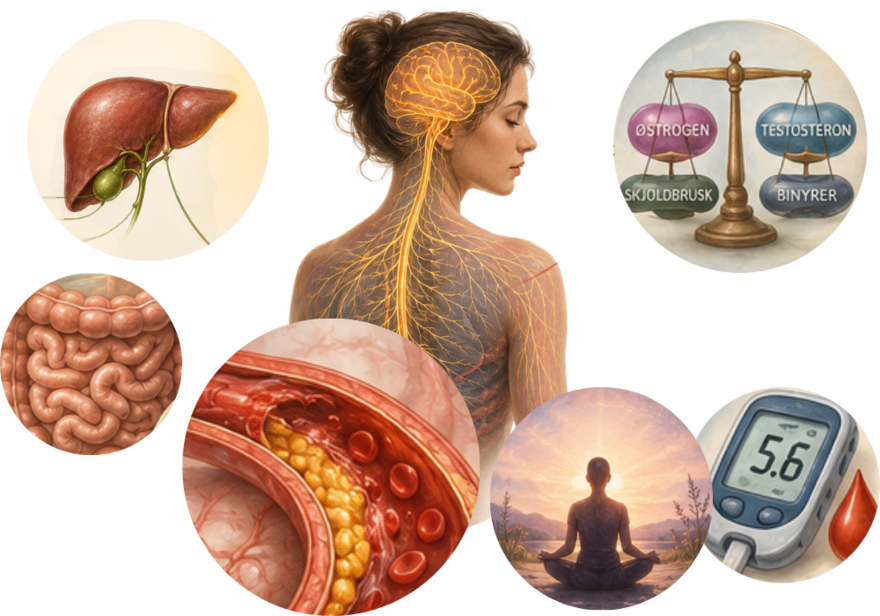
The liver produces the majority of the body’s cholesterol. It regulates fats, produces bile, and handles a huge number of metabolic processes. If the liver is stressed — by chronic stress, poor diet, medication use, inflammation, or metabolic imbalance — cholesterol regulation will change accordingly.
Closely connected to the liver is the gallbladder. Cholesterol is primarily excreted via bile, and a well-functioning bile flow is essential for the body’s ability to process and eliminate excess fat. When bile flow is sluggish, digestion is impaired and cholesterol metabolism becomes less efficient. This is a connection that many therapists overlook.
In the treatment plan, I work with reflex zones for the liver, gallbladder, duodenum, and pancreas as a complete functional system — not as isolated organs.
The intestinal system, blood sugar and hormones
Recent research increasingly points to a connection between gut flora and cholesterol regulation. Certain gut bacteria are directly involved in cholesterol metabolism. Chronic inflammation, dysbiosis, and impaired nutrient absorption affect the body’s ability to regulate itself. Clients with elevated cholesterol often also have digestive problems — constipation, bloating, irregular bowel movements. This is no coincidence.
Another important factor is blood sugar regulation. Many clients who present with elevated cholesterol actually have a glucose regulation problem—insulin resistance or metabolic syndrome—rather than an isolated cholesterol problem. Elevated triglycerides and abnormal cholesterol profiles are frequently seen in conjunction with high insulin levels. It’s the same underlying picture, seen from two sides.
The hormonal system plays a similar role. Cholesterol is the raw material that the body uses to produce hormones. During menopause, andropause, with decreased thyroid function or with prolonged adrenal stress, the body’s relationship to cholesterol changes. Looking only at laboratory numbers without assessing the endocrine status gives an incomplete picture.
Chronic inflammation — perhaps the most important perspective
Many researchers now view elevated cholesterol as part of the body’s repair mechanism rather than as the primary cause of cardiovascular disease. Cholesterol often accumulates where there is irritation, inflammation, or tissue damage in the vascular system. Traditionally, this presence has been considered the cause of the problem. However, in many cases, it may represent the body’s attempt to repair tissues that are already under stress.
This doesn’t mean that elevated cholesterol should be ignored. It means that we should investigate what is driving the inflammation in the first place.
Poor diet, smoking, chronic stress, a sedentary lifestyle, sleep problems, and untreated inflammatory conditions all affect the body’s internal environment. As neuroreflexologists, we know that the nervous system plays a central role in regulating these processes. Chronic activation of the sympathetic nervous system affects blood sugar, digestion, hormone production, circulation, and inflammatory responses throughout the body.
Therefore, support for the nervous system is at least as important as support for the liver and digestive system.
The clinical approach
When I work with clients who have high cholesterol, the goal is not to change a number. The goal is to help the body regain balance in the systems that govern health: the liver, digestive system, hormonal system, circulatory system, immune system, and nervous system.
In practice, this means that I evaluate liver function and bile flow, the state of the intestinal flora, blood sugar regulation, hormonal balance, the degree of chronic inflammation, and the load on the autonomic nervous system. The treatment protocol is built on the overall picture — not on the individual number.
The body has an extraordinary ability to regulate itself. When digestion is improved, inflammation is reduced, stress is managed, hormonal balance is restored, and circulation is supported, cholesterol regulation often normalizes as a natural part of a broader physiological balance.
Cholesterol is not the body’s enemy. It is part of a complex biological conversation that takes place in the body every single day. The better we learn to listen to that conversation, the better we will be able to support real clinical change.
With love