
By Lone Sorensen
Tinnitus is often accompanied by hypersensitivity to noise, and depending on its intensity and frequency, it can significantly affect quality of life, including the ability to work and concentrate.
It may also contribute to stress, anxiety, depression, fatigue, and emotional distress.
Successful outcomes for clients with tinnitus using Neuro Reflexology are based on a deep understanding of the many possible causes, together with the use of neurologically related microsystem methods.
This makes it possible to create a specific and personalised treatment plan for each individual client.
Tinnitus is the perception of sound without an external source. It may be experienced as buzzing, ringing, hissing, pulsing, or other auditory sensations, and it can affect one or both ears. There are more than 40 possible causes of tinnitus.
The Causes of Tinnitus
Tinnitus is not a disease in itself. It is a symptom and a sign that something is wrong within the auditory system, which includes the ear, the auditory nerve that connects the inner ear to the brain, and the parts of the brain that process sound. Even something as simple as earwax blocking the ear canal can cause tinnitus. However, it may also be linked to a number of health conditions, including:
- Noise-induced hearing loss
- Exposure to extremely high noise levels
- Ear and sinus infections
- Diseases of the heart or blood vessels
- Ménière’s disease
- Brain tumours
- Hormonal changes in women
- Thyroid abnormalities
- And more
Tinnitus can also be the first sign of hearing loss in older adults. In some cases, it is a side effect of medication. More than 200 drugs are known to cause tinnitus.
People who work in noisy environments, such as factory workers, construction workers, road crews, and musicians, may develop tinnitus over time when repeated noise exposure damages the tiny sensory hair cells in the inner ear that help transmit sound to the brain. This is known as noise-induced hearing loss.
Military personnel exposed to bomb blasts may also develop tinnitus if the shock wave damages brain tissue involved in sound processing. Tinnitus is one of the most common service-related disabilities among veterans returning from war.
Pulsatile tinnitus is a rarer form of tinnitus, described as a rhythmic pulsing in the ear, often in time with the heartbeat. This type is most commonly associated with problems in blood flow in the head or neck, although it may also be caused by brain tumours or structural abnormalities in the brain.
Although tinnitus is not usually a sign of a serious illness, when it is severe it can lead to fatigue, depression, anxiety, and difficulties with memory and concentration. For some people, it can also be a source of considerable mental and emotional distress.
Noise in the Brain
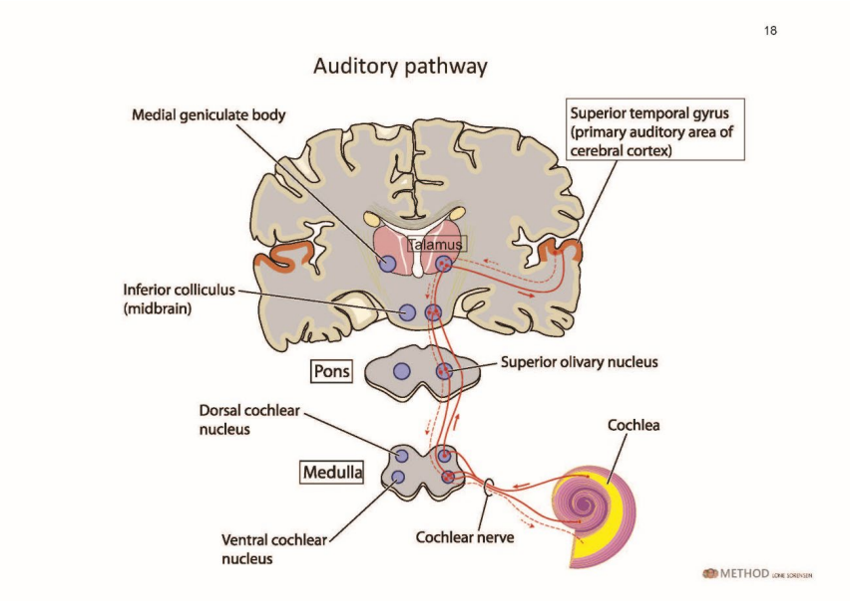
Although tinnitus is heard in the ears, its source is often found in the networks of brain cells within the neural circuits that interpret sound.
Tinnitus may develop when the brain attempts to adapt to the loss of sensory hair cells by increasing sensitivity to sound. This may help explain why some people with tinnitus are also oversensitive to loud noise.
It may also occur when neural circuits become unbalanced after any inner ear damage changes signalling activity in the auditory cortex – the part of the brain responsible for processing sound. Another possibility is abnormal interaction between different neural circuits.
The hearing pathways are not dedicated solely to sound; they also communicate with other areas of the brain, including the limbic system, which regulates mood and emotion.
In some cases, tinnitus can become so severe that it interferes with hearing, concentration, and sleep.
Tinnitus and Neuro Reflexology
With Neuro Facial and/or Foot Reflexology, it is possible to help clients influence the severity of tinnitus-related auditory sensations and their impact on daily life. The neurological approach used in Neuro Reflexology employs microsystems that allow very precise stimulation of the structures involved in hearing, including the ear, cranial nerves, and the brain pathways responsible for sound processing, such as the auditory nerve that connects the inner ear to the brain.
Some of the nerves and brain structures that may be involved in tinnitus include:
- The vestibulocochlear nerve, or eighth cranial nerve, which carries signals from the inner ear to the brain. In some cases, damage or dysfunction in this nerve may be linked to tinnitus.
- The vagus nerve, which may influence the balance of signals reaching the auditory cortex.
- The auditory thalamus, or medial geniculate body (MGB), which plays an important role in filtering and relaying sound perception to the auditory cortex and limbic system. Dysfunction in this pathway may contribute to tinnitus.
- Tight neck muscles and temporomandibular joint dysfunction (TMJ), which may place pressure on spinal nerves connected to the brainstem and affect blood circulation to the ear and brain.
As a therapist, it can be challenging to identify the exact origin of a client’s tinnitus. However, with facial reflexology it is possible to carry out a detailed manual assessment and determine where the issue may be arising, allowing for the development of an appropriate and individualised treatment protocol.
Treatment Approach
Successful outcomes for clients with tinnitus using Neuro Reflexology are based on a strong knowledge of the many possible causes, together with the appropriate neurologically related microsystem methods. This provides a framework for developing a specific and personalised treatment plan for each individual client.
The number of treatments required depends on the cause and on how chronic the client’s condition is. Treatment is most commonly carried out once a week, and in many cases, around 8 to 12 treatments may be needed to see significant results.